

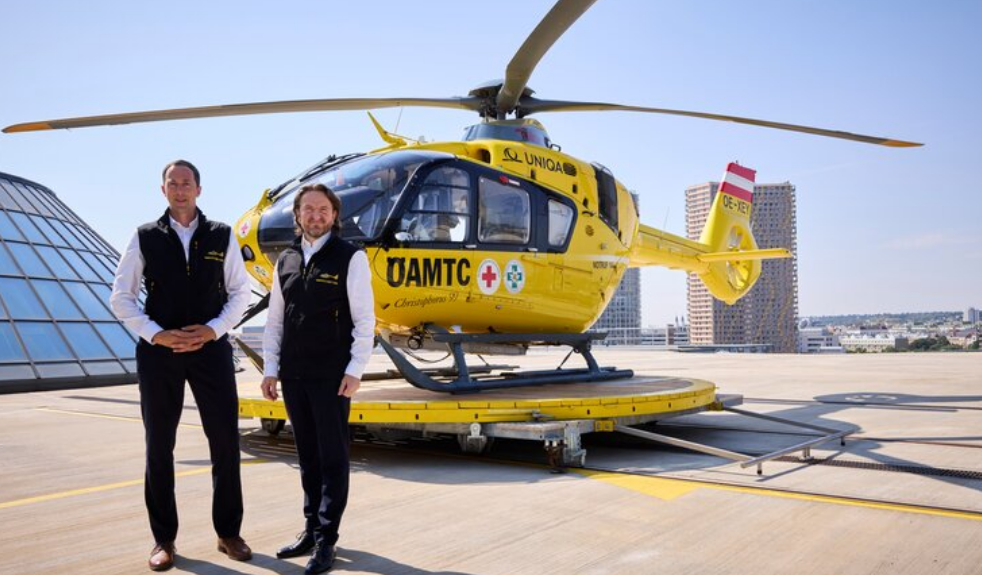
The anniversary underscores its importance to emergency care and the healthcare system.
On May 14, 2026, the ÖAMTC Air Rescue Service was dispatched for its 500,000th mission—a milestone that underscores the central role of the Christophorus fleet in emergency medical care. The anniversary mission was flown by Christophorus 18: The emergency medical helicopter, which has been stationed in Frauenkirchen (Burgenland) since January 2025, was dispatched to a neurological emergency in northern Burgenland. After receiving successful initial treatment, the patient was flown to Vienna General Hospital (AKH Wien).
Marco Trefanitz, CEO of ÖAMTC Air Rescue
“Half a million calls are unprecedented in Austria. For us, however, the focus is not on the numbers, but on the people: patients who need rapid medical assistance—and, of course, our crews and staff, who are there for the public 365 days a year. Without their dedication, professionalism, and high level of commitment, none of this would be possible.”
The origins of the ÖAMTC Air Rescue Service date back to 1983, when the first bases—Christophorus 1 in Innsbruck and Christophorus 2 in Krems—began operations. In the first year, only 191 missions were flown. Since then, the system has been continuously expanded. Trefanitz: “In 2001, we took over seven air rescue bases that had previously been operated by the Ministry of the Interior—a decisive step toward the comprehensive network of emergency medical helicopters that Austria has today.” The ÖAMTC Air Rescue Service now operates 24 bases, including four seasonal bases and one intensive care transport helicopter. Each year, the crews are dispatched to more than 21,000 missions.
The nature of the emergencies has changed significantly: While traffic accidents initially dominated, today internal medicine and neurological conditions—particularly cardiovascular diseases and strokes—are at the forefront. Time and rapid response are critical factors, especially in these emergencies. “In the case of heart attacks and strokes, the rule is: The faster patients are transported to the right hospital, the better their chances of successful treatment and the lower the risk of permanent damage,” explains Trefanitz.
A study commissioned by ÖAMTC Air Rescue shows the impact that air rescue has beyond immediate medical care. “We looked specifically at heart attacks and strokes because both conditions are often associated with serious long-term consequences,” explains Trefanitz. “Thanks to rapid care and swift transport to specialized centers, the chances of successful treatment increase significantly.” The analysis also shows that these rapid transport times have an impact not only medically but also economically. “For every euro invested in air rescue, there is a return of about ten to twelve euros. This is primarily due to lower follow-up costs resulting from avoided or reduced long-term damage,” says Trefanitz.
The quality of operations is based on standardized procedures and well-coordinated crews consisting of pilots, emergency physicians, and air rescue personnel. At the same time, the system has been continuously refined in all areas over the years. “It’s not just about the number of bases, but about the entire system behind it—from maintenance and training to medical equipment. And, of course, it’s also about integration into the broader emergency medical services system,” emphasizes Klaus Schwarzenberger, COO of ÖAMTC Air Rescue. “Developments are ongoing and take place simultaneously in many areas. This is an essential prerequisite for our ability to maintain high quality standards over the long term.”
An important step was the introduction of 24-hour operations at select locations. Since 2017, emergency medical helicopters have been available around the clock in parts of Austria. Developments are also being driven forward in the technical sector, for example through the company’s own maintenance and design division, HeliAir. Concepts such as the “Kokon” cabin solution and the “Phoenix” lighting system have also garnered international attention.
In the coming years, the focus will be on further expanding existing structures and exploring new technological possibilities. This includes, among other things, the necessary modernization of the fleet with the new H140 generation of helicopters. In addition, satellite-based flight procedures are being developed to enable missions even under more challenging weather conditions. Furthermore, new types of operations are being explored. One possible future approach is the use of drones to transport medical supplies between hospitals.
For the CEO of ÖAMTC Air Rescue, the 500,000th mission is certainly also an opportunity to look ahead. “Our goal remains to continue developing the air rescue system together with our partners. We want to continue providing people in Austria with rapid medical assistance of the highest standard in the future,” says Trefanitz. “But one thing is also clear: The demands on emergency medical care are constantly changing, while resources are becoming scarcer. There’s one thing, however, that we must always keep in mind: Emergencies don’t adhere to a schedule—nor do they conform to budgetary considerations.”
Become a supporting member and help strengthen air rescue services in Austria for the long term.
You are currently viewing placeholder content from Vimeo. To access the actual content, click the button below. Please note that doing so will result in data being shared with third-party providers.
More InformationYou are currently viewing placeholder content from YouTube. To access the actual content, click the button below. Please note that doing so will result in data being shared with third-party providers.
More InformationYou need to load content from reCAPTCHA to submit the form. Please note that doing so will result in data being shared with third-party providers.
More InformationYou are currently viewing placeholder content from Google Maps. To access the actual content, click the button below. Please note that doing so will result in data being shared with third-party providers.
More InformationYou are currently viewing placeholder content from OpenStreetMap. To access the actual content, click the button below. Please note that doing so will result in data being shared with third-party providers.
More InformationYou are currently viewing placeholder content from Mapbox. To access the actual content, click the button below. Please note that doing so will result in data being shared with third-party providers.
More Information